

From childhood passions to a dream career

Nina Hedberg
Jun 16, 2026 7:30:02 AM
Interior architect and designer Minna Haapakoski still gets just as excited about every new project. Her work spans product design, private homes and public spaces, and she has designed the interiors of several television programs.
Minna Haapakoski's interest in interior design and form started in her early childhood. She has loved interiors and beautiful shapes for as long as she can remember. "At home growing up, the interiors were constantly being redone. My sister, my mother and I shuffled the old furniture around into new arrangements. Where we lived in Pohjois-Pohjanmaa (Northern Ostrobothnia), in Ylivieska, we called it möbleeraaminen – rearranging," Minna says of her early memories.
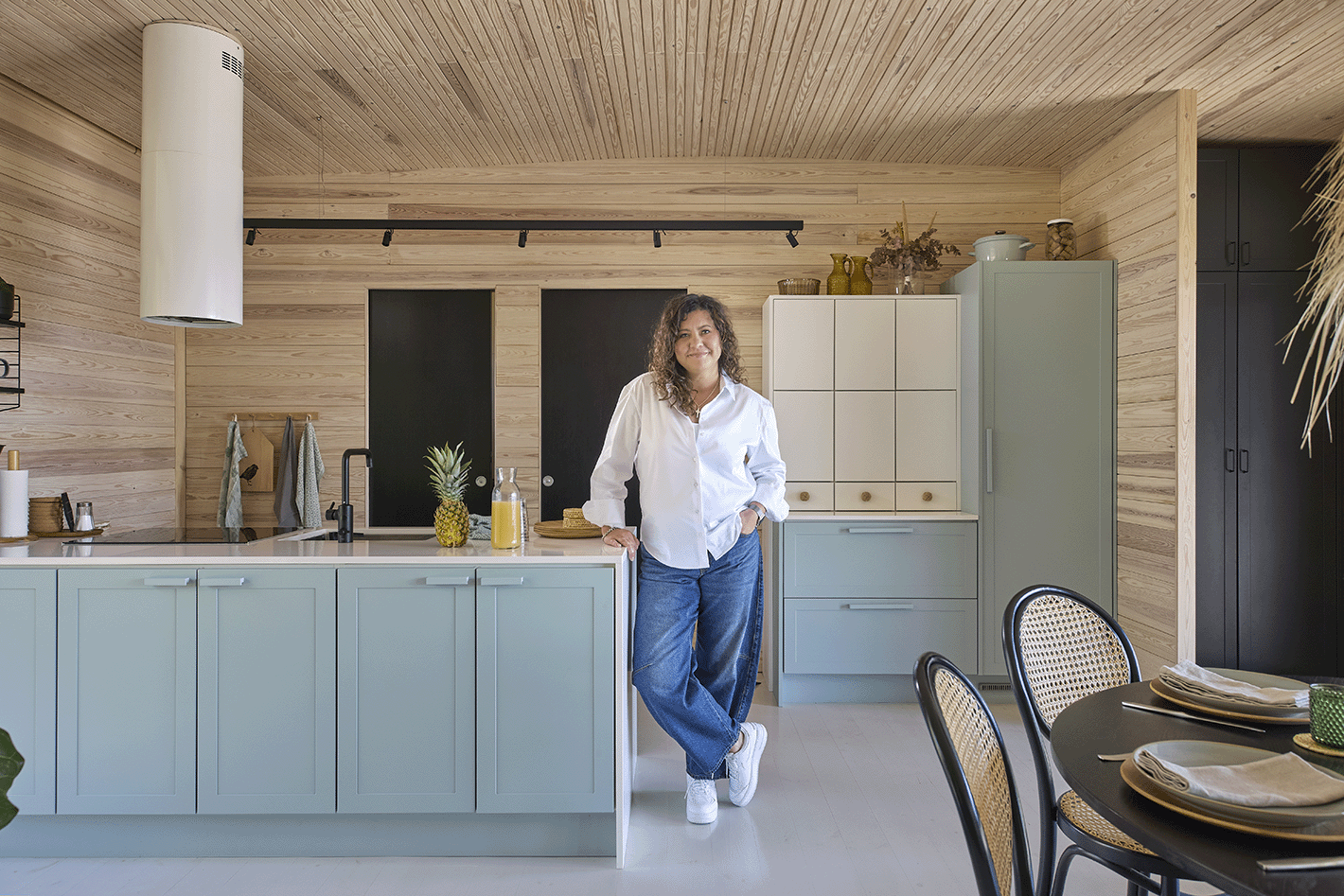
Minna Haapakoski in her summer cabin. Photo: Hans Koistinen
Now 44, she lives in the Uusimaa region with her husband and their 13-year-old son, and her business turns 20 next February. "I am genuinely grateful for all the different experiences I have got to live through and create over the years, and that there has always been enough work. It has been wonderful to spend this long working as a solo entrepreneur in a vocation that feels like a calling. I am so happy that the passion for this profession has stayed and never disappeared," Minna says.
AN ENTHUSIASTIC INTERIOR ARCHITECT FROM POHJOIS-POHJANMAA
Minna's interest in interiors began as a child, playing with Barbie dolls. She always built homes for all of the dolls from materials she made herself, because in the recession years of the 1990s there was no money for real doll furniture.
"I had a very rich imagination already as a child, and I would invent homes and interiors for the dolls. At some point it got to the point where I had to build homes for everyone before we could actually start playing. My friends always thought my homes were the best," Minna laughs.
Minna has always had an immense urge to make things and arrange them. Alongside her playing, she loved rearranging her childhood home. Even though new furniture was not bought, the interior changed by shifting things around. Woolen socks were placed under the furniture so it would slide more easily. She moved pieces with her mother and sister, then sat back and tried different positions until the right one was found.
These beloved childhood interests eventually led her to study as a textile artisan, and then take a degree in visual merchanidizing. After that she studied interior architecture and design at a university of applied sciences, because beautiful forms interested her just as much as inviting spaces. She graduated from North Karelia University of Applied Sciences in interior architecture and furniture design in 2008.
THE DESIGN OF A BIG BROTHER HOUSE AS STEPPING STONE FOR HER CAREER
Before graduating, Minna landed an internship on Inno, a Finnish interior design and renovation tv program, where she worked as assistant to interior architect Marko Paananen. This turned out to be a pivotal place for her career, because in 2007 the same production company was also making Big Brother. As a bold and enthusiastic interior architect at the start of her career, Minna decided to ask the producer whether she could design the next Big Brother house. She ended up competing against two professional set designers, and was chosen as the house's designer.
"It was completely surreal that, as my very first job, I got to do such a visible project, which was on TV every day for a long time. I founded my own design studio for it, even before graduating as a designer. Designing the 2007 Big Brother house opened up my career in an incredible way and helped me move forward in the industry. It was a real stepping stone," Minna says of her career's beginning.
Through this highly visible reference, Minna also joined a number of other TV productions. Finland's television industry is relatively small, and the same people often move between production companies. Through recommendations, Minna gradually built her network and worked as an interior designer for several production houses.
In addition to the 2007 and 2010 Big Brother houses, she has designed two houses for Finland's Top Model series, set-designed the Miss Finland pageant three years running, and designed balconies on the show Ihana Piha (Lovely Garden) for several seasons. She also travelled to Spain to design the interior of Finland's Love Island villa. Camera work and partner sponsorships brought their own constraints, but in these interior projects Minna has been able to bring her own ideas forward and work relatively freely.
Minna landed on the interior show Tyylivarkaat (Style Thieves) via a recycling project, when she fitted out various spaces in the Helsinki metropolitan area's Recycling Centre stores using only second-hand materials. At the end of the project, news reporter Mika Tommola visited one of the stores to film a lighter news closer, and Minna ended up playing a couple in a bedroom scene with him. After the segment aired, she got a call asking her to be the second interior designer on a new Tyylivarkaat series.
Minna was thrilled: "Tyylivarkaat ran for two seasons, and on it I got to design private clients' homes. It was wonderful, because it felt like our own show."
Her most recent TV project was designing a home gym for fitness trainer Vertti Harjuniemi on his own program.
DESIGNING A FANTASY HOME
In the early years of Minna's business, TV programs acted as a marketing channel, and private clients soon started asking her to design their homes. One project that stuck with her was a three-story detached house, because she got to design something genuinely different and unique.
The clients were fans of fantasy films and wanted their home to reflect a fantasy world. The house had several bathrooms, and they wanted to convert one of them into a spa room. The space had two showers and a whirlpool tub, but they only wanted a single shower. The space, however, was large and could not be made smaller because of the load-bearing structures. "Then I had the idea of an enormous round rainfall shower, two meters in diameter. It turned out to be really spectacular. It is like a waterfall flowing over natural stone," Minna says of this unusual project.
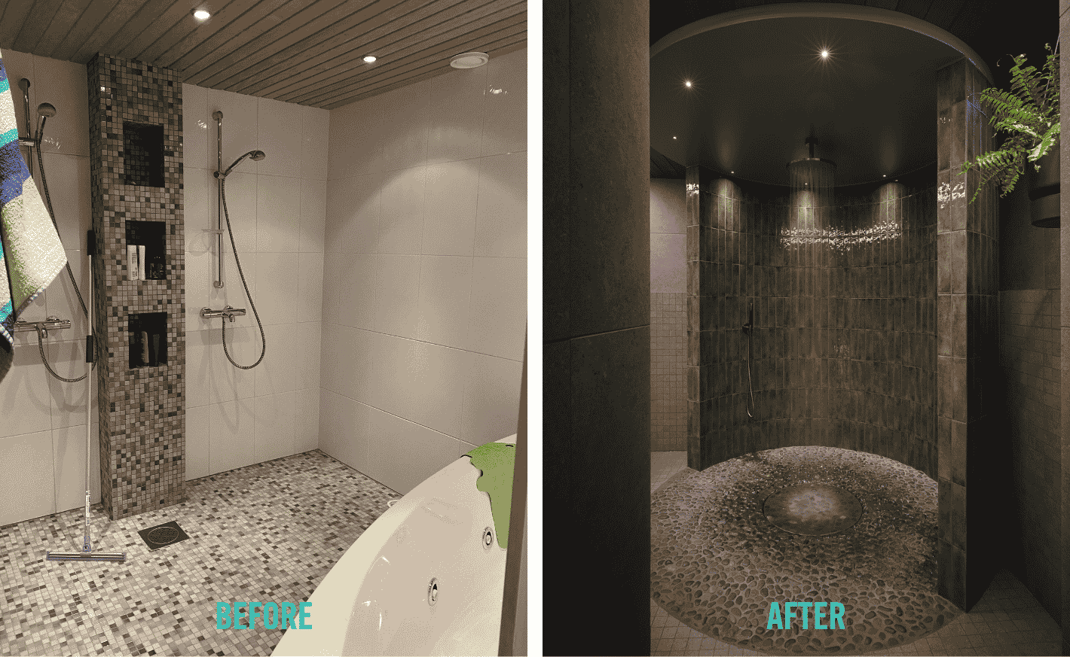
Shower before and after. The curved shower serves as a striking design feature in the bathroom. Before photo: Minna Haapakoski, After photo: Ville Heino
Behind the spa room's glass partition, on the dressing-room side, sits a giant Spanish-designed clothespin bench as part of the fantasy world.
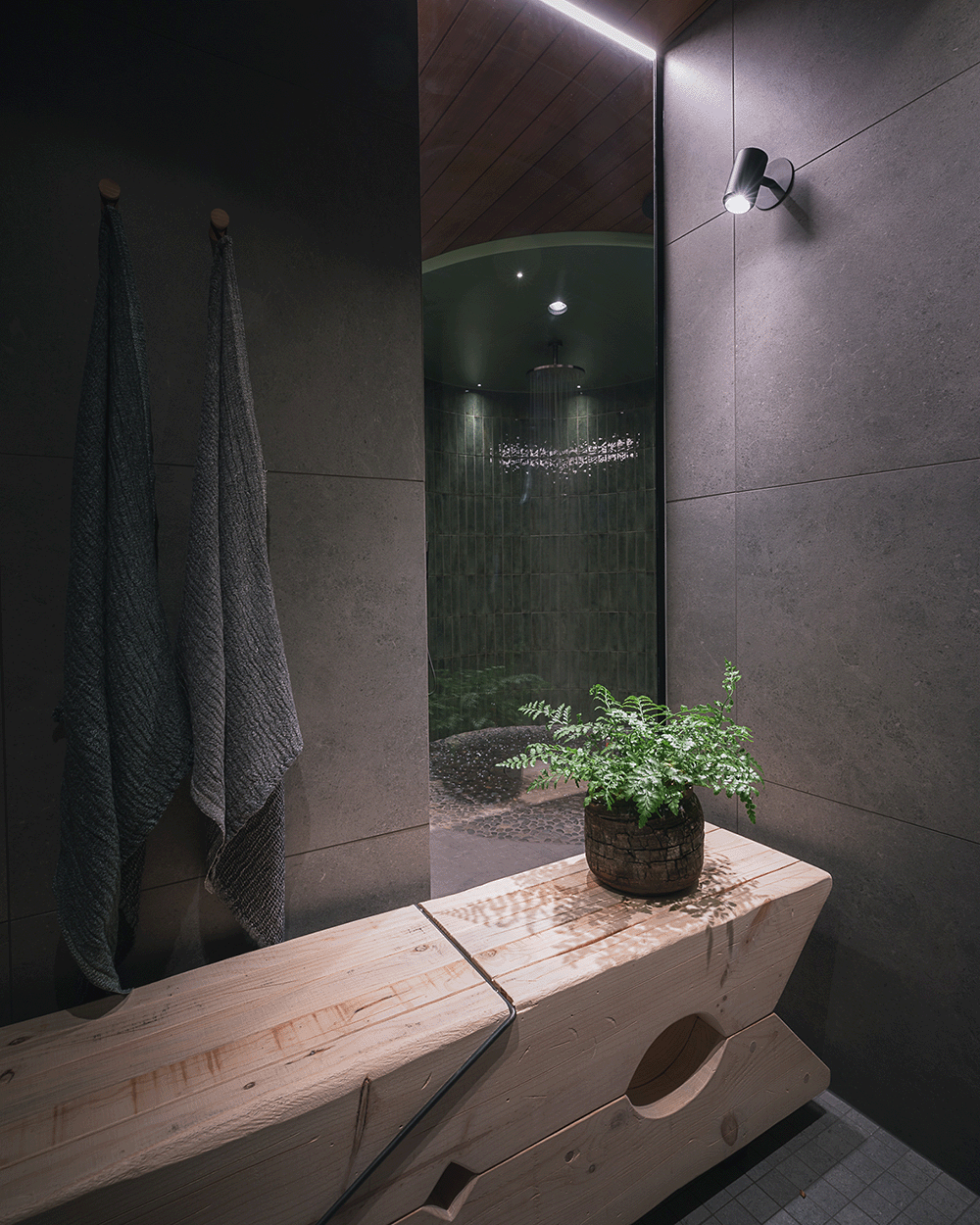
The bathroom has a curved shower enclosure and a large clothespin. Photo: Ville Heino
In the same home, Minna designed a office space for the father of the family, which also serves as his man cave. The lower floor was completely transformed once it was split into three. In the middle there is a gaming area, and even the entrance to the room takes its cue from the gaming world. You enter through a hidden door behind a mirror, and on the other side waits a full-size armor, a piece from his game-collectibles.
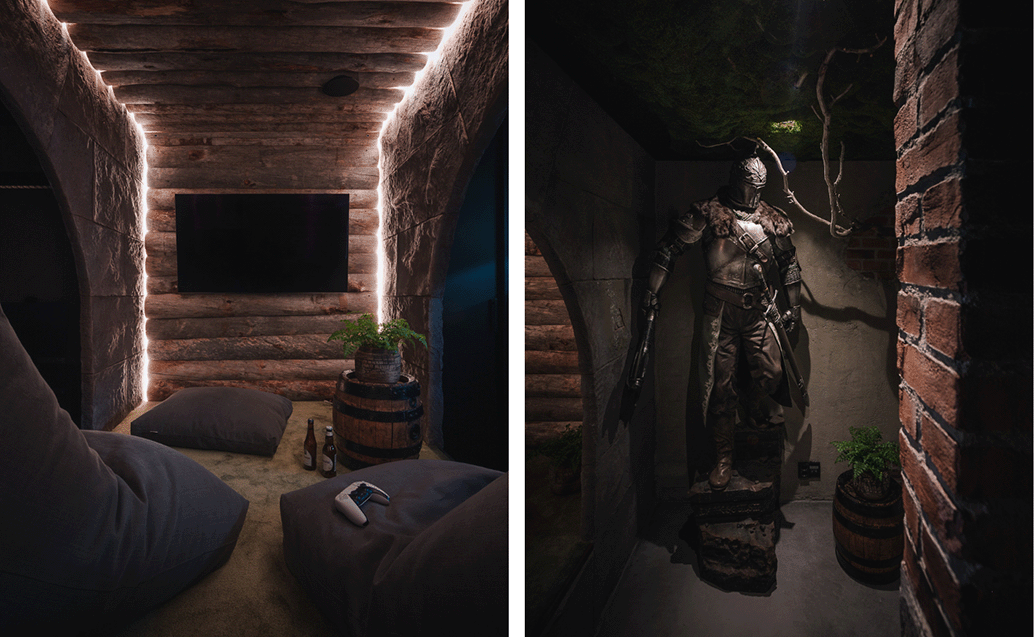
In the father's office room, there's a play area, and behind a secret door, there's a huge suit of armor. Photos: Ville Heino
The mother got her own room too. For her, Minna designed a blue atelier. The room has a blue-tinted parquet floor, and behind a large blue built-in unit a relaxing dream-nook opens up.
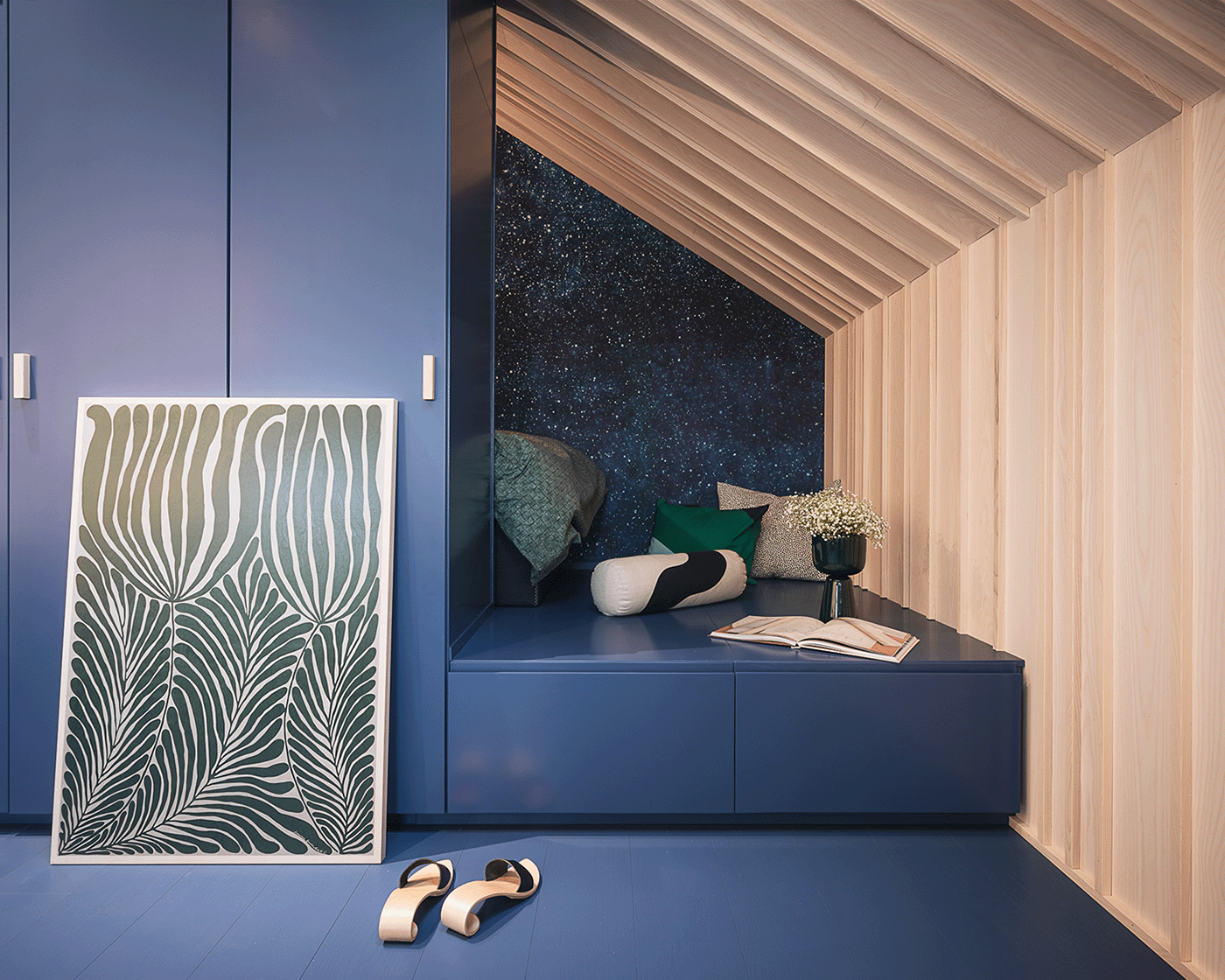
The mother's studio has blue hardwood floors and blue built-in furniture. Photo: Ville Heino
"The fantasy home project was really enjoyable for me and for the creators. I want to thank in particular the craftspeople and the people who actually built the spaces, because no matter how good the design, if the builders do not follow the drawings, the result will not be as fine as this. It takes all of us to make the result what the client wanted and the very best it can be," Minna says.
Her client was very happy with the outcome too: "Working with Minna was genuinely fun. We did not have to worry about organizing things at all, and best of all, every order arrived on time and the project did not slip. We had some pretty wild ideas in the mix, and in the end all of them came together. With Minna's help the final result stayed stylish and did not slip into tackiness, which could easily have happened on our own," the satisfied homeowner said once their unusual home was finished.
RETRO GLASS IN PRIVATE HOMES AND RESTAURANTS
During her career, Minna has succeeded not only as an interior architect but also as a product designer. The Retro glass she originally designed for the sauna door in her own holiday home, hand-made for the project, turned out so beautifully that Essis by Lasilinkki in Kuopio took it into their collection, and it is now one of their best-selling artisan glass models. It has been used in private homes on sauna and bathroom doors, and also in hotels and restaurants.
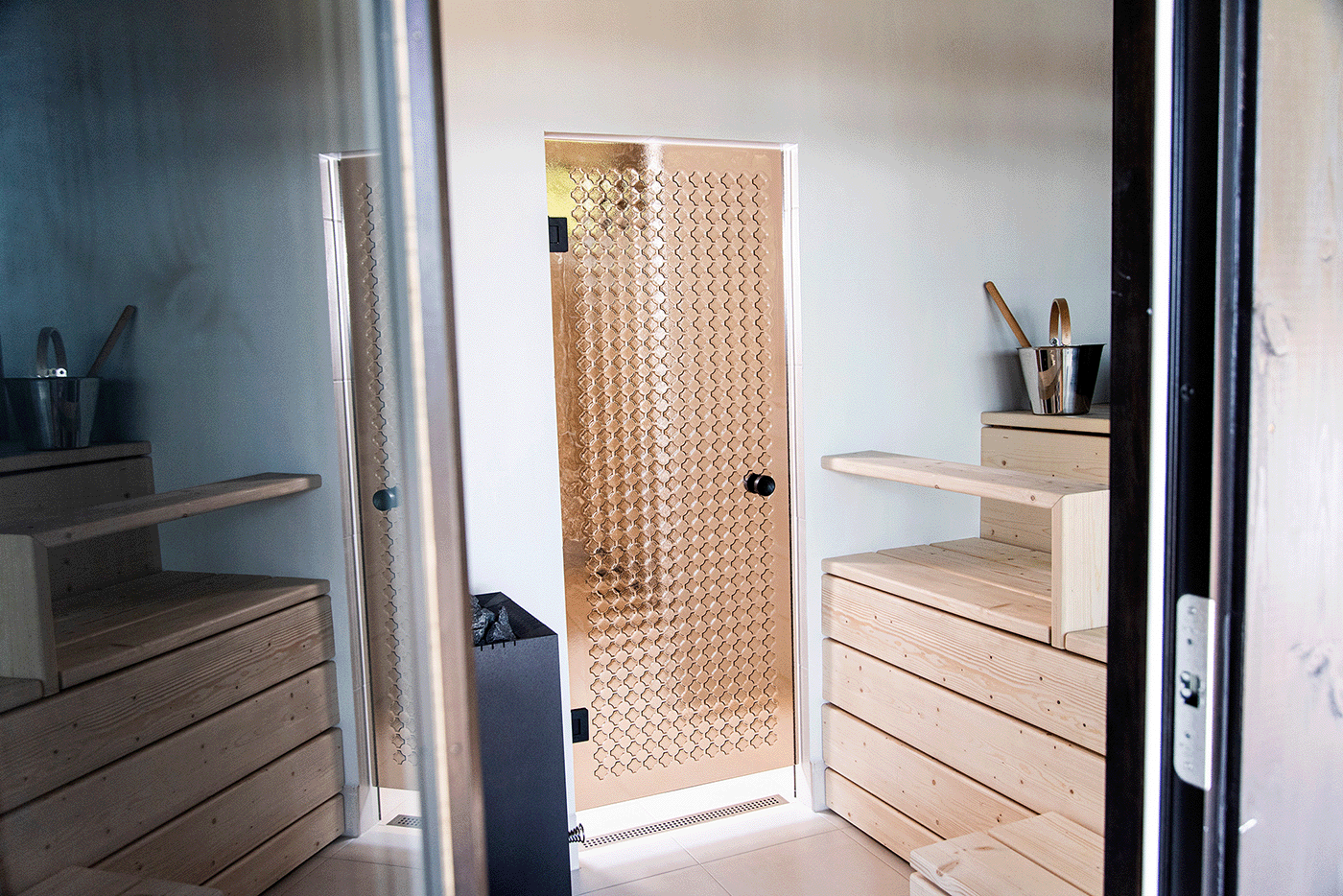
Retro glass in the door of Minna Haapakoski's sauna. Photo: Saku Tiainen
The Retro glass idea began with Minna wanting traditional bottle-bottom glass in her sauna door, but its properties made it impossible to use. While looking for alternatives, she remembered a pattern she had designed a few years earlier for the stairwell of a Helsinki apartment building. Essis by Lasilinkki was able to make the glass Minna wanted from that pattern by hand, and the successful Retro glass was born.
Retro glass is now available in eight shades, including blue, grey and clear, but the original bronze brown remains the bestseller.
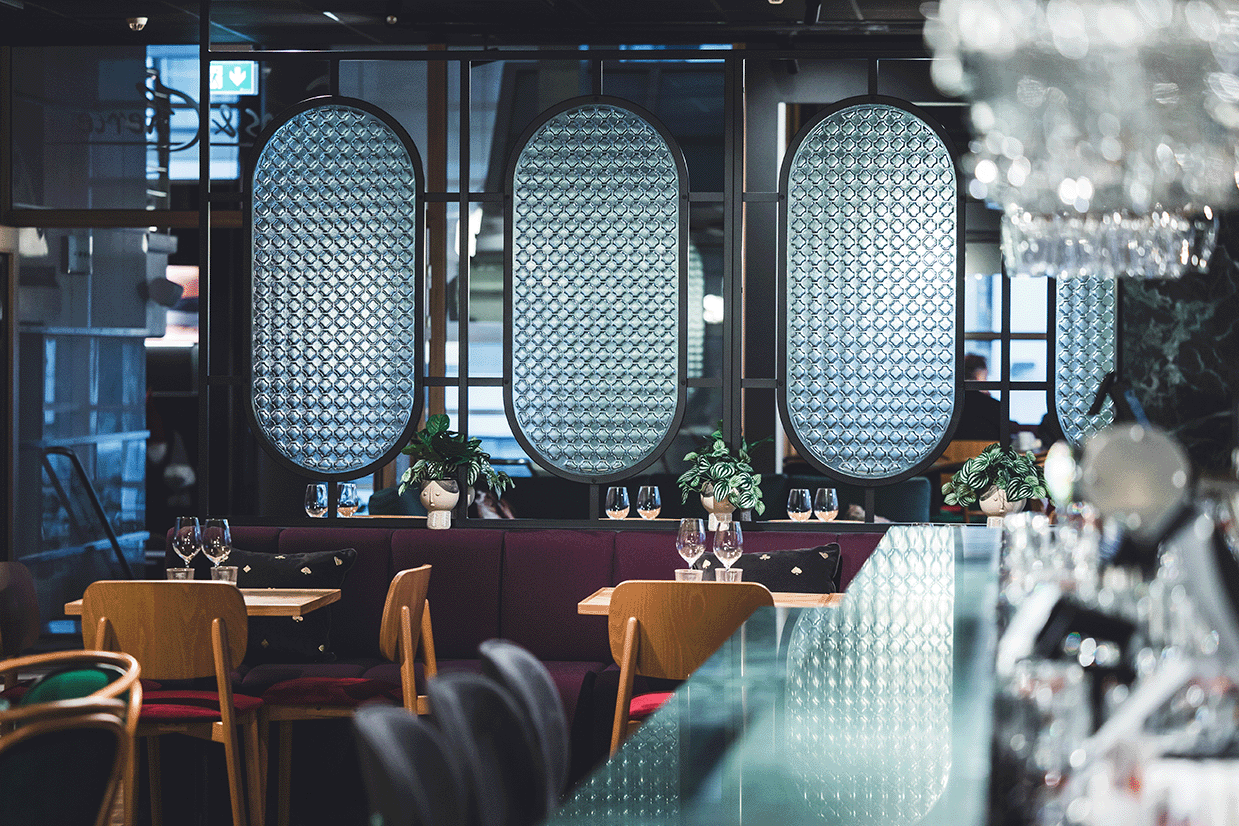
The Retro artisan glass was custom-made to serve as room dividers at the Frans & Cherie restaurant at Sokos Hotel Vaakuna in Rovaniemi. Place: Ravintola Frans & Cherie, Rovaniemi; Interior design: Kate Salminen and Paula Kouri; Photographer: Milladephoto / Milla Keskipoikela
AWARD-WINNING PRODUCT DESIGN
Minna has also won awards for her product designs. In 2023, together with her design team, she won a European Product Design Award when the LINE ventilation valve they had designed for Climecon was
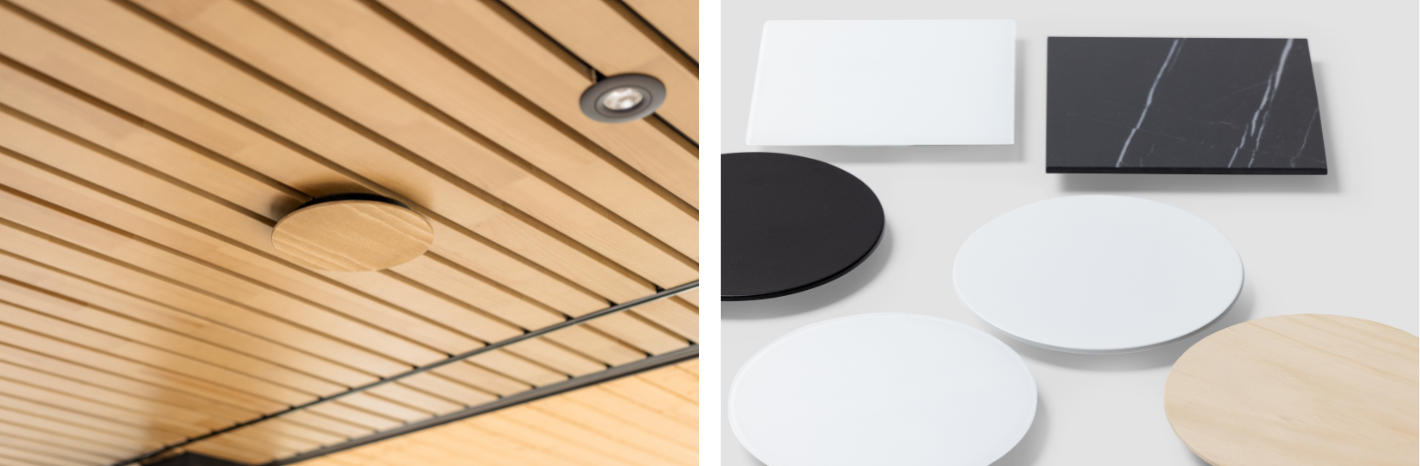
LINE ventilation valves. Images: Climecon
"As in that simple disc on the ventilation valve, the round form keeps reappearing in my work. To me it is timeless and fascinating. I love the round shape. That is how you recognize me," Minna says of the signature in her designs.
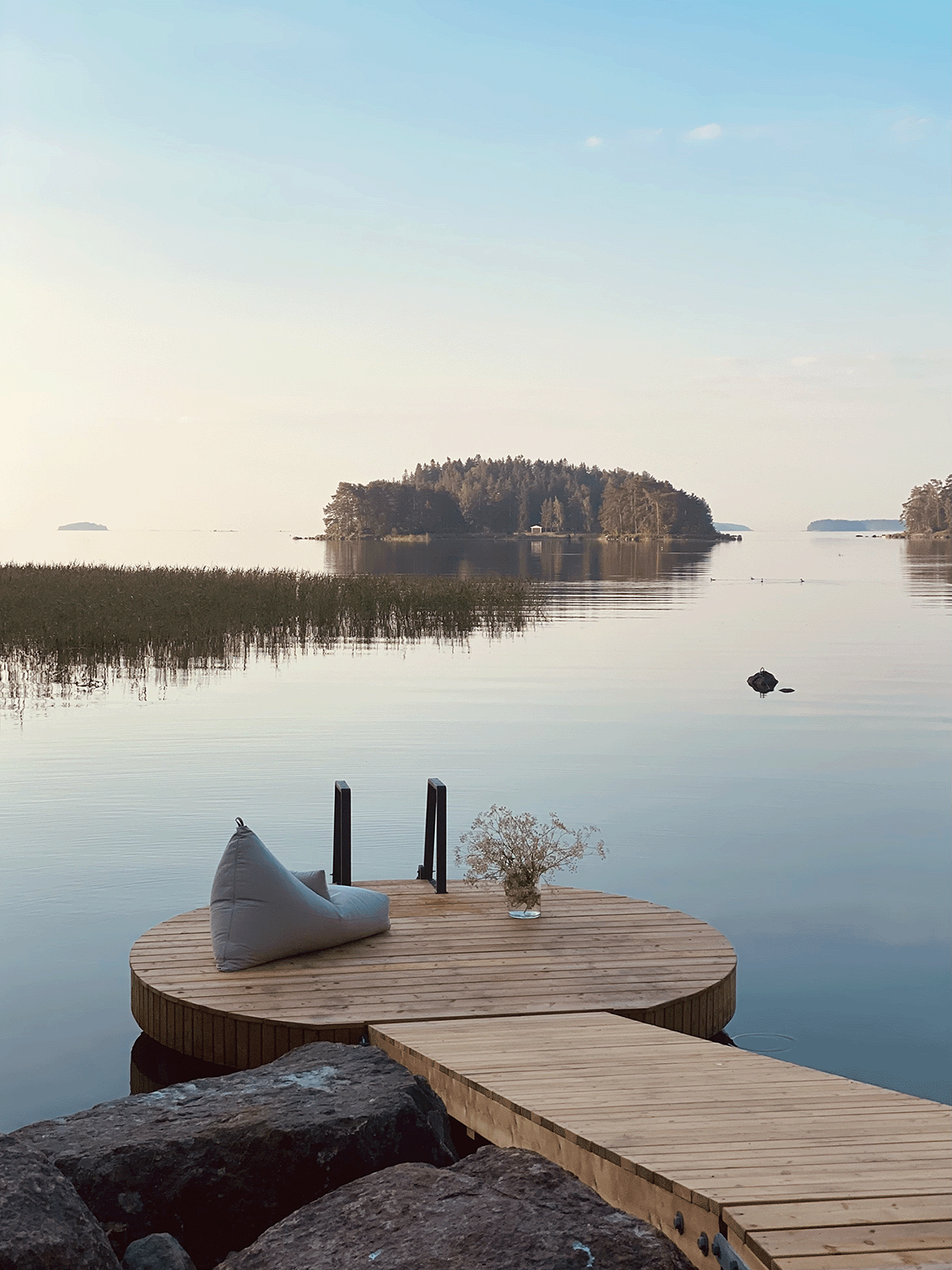
The round form also recurs in the Lounge pier Minna designed for Savorak. Photo: Minna Haapakoski
In 2017 Minna received another recognition when the Finnish Interior Design Editors selected her PETI bed among the twelve most interesting Finnish interior products of the year.
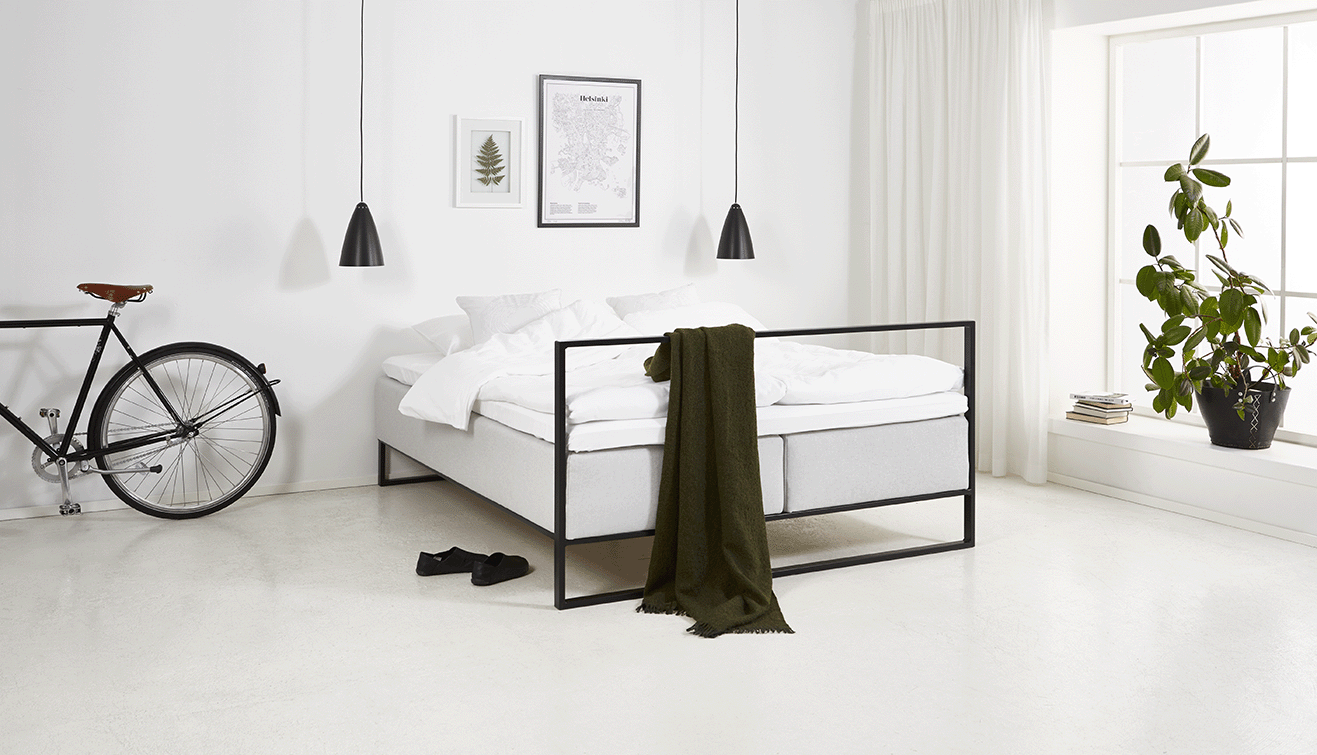
The PETI bed provides a place for a bedspread. Photo: Esa Pasanen
"The bed's idea and design came from my own need. The bedspread was always in a heap at the foot of the bed, and I was afraid our child would trip over it on his way to our room at night. I had the idea of a light frame that integrates with box-spring beds, with a slot at the foot where the cover can be stored safely and, most of all, tidily. People particularly liked the simple thought behind the bed," Minna says.
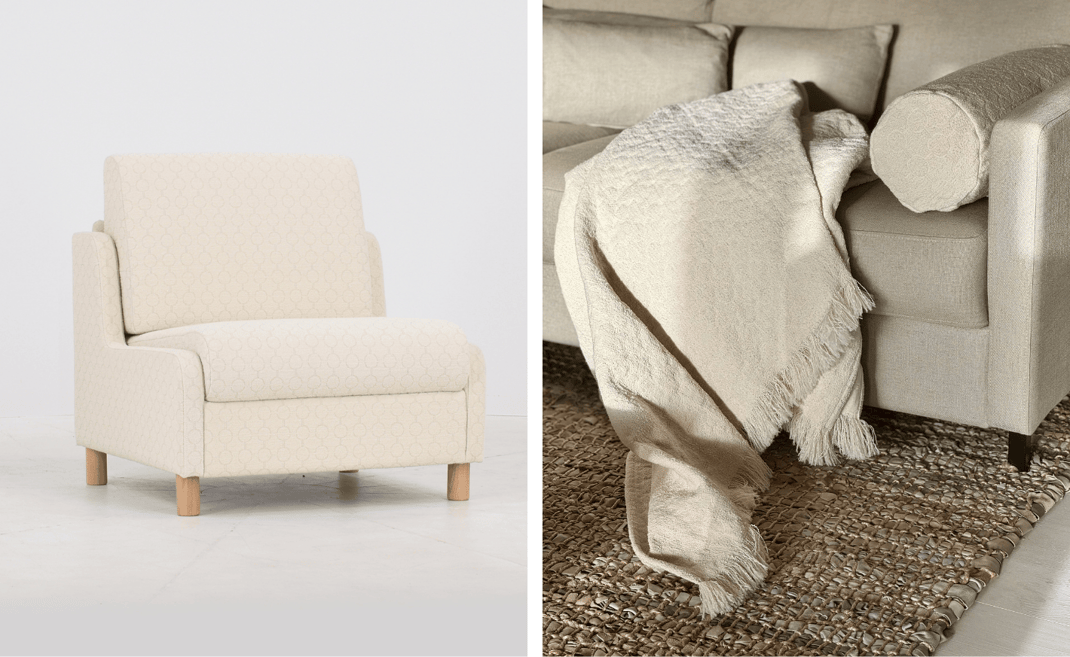
Minna also designed the HELMI pattern for the Annala collection. Here featured on an armchair (on the left) and on a blanked and a pillow (on the right). The pattern repeats the shape familiar from the Retro glass. Left photo: Finsoffat, right photo: Minna Haapakoski
BRAND-NEW DESIGN
Minna constantly has new design ideas. Most recently she designed the LUMO product family for Pieksäwood, in collaboration with Cariitt. The idea came on a run: "I got the idea for this product family while jogging around our holiday home, looking at the timber cladding on old wooden houses, where a narrow lath covers the joint between two boards every time. I thought, what if you transferred that idea to a tongue-and-groove panel and milled grooves into the rib panels ready for indirect lighting? After the run I was in a hurry to start drawing the idea in Archicad so I could present it to Pieksäwood."
The LUMO product family is customisable to client wishes. Between the panels you can pick the STS-0 panel from Pieksäwood and design the whole composition to your own taste.
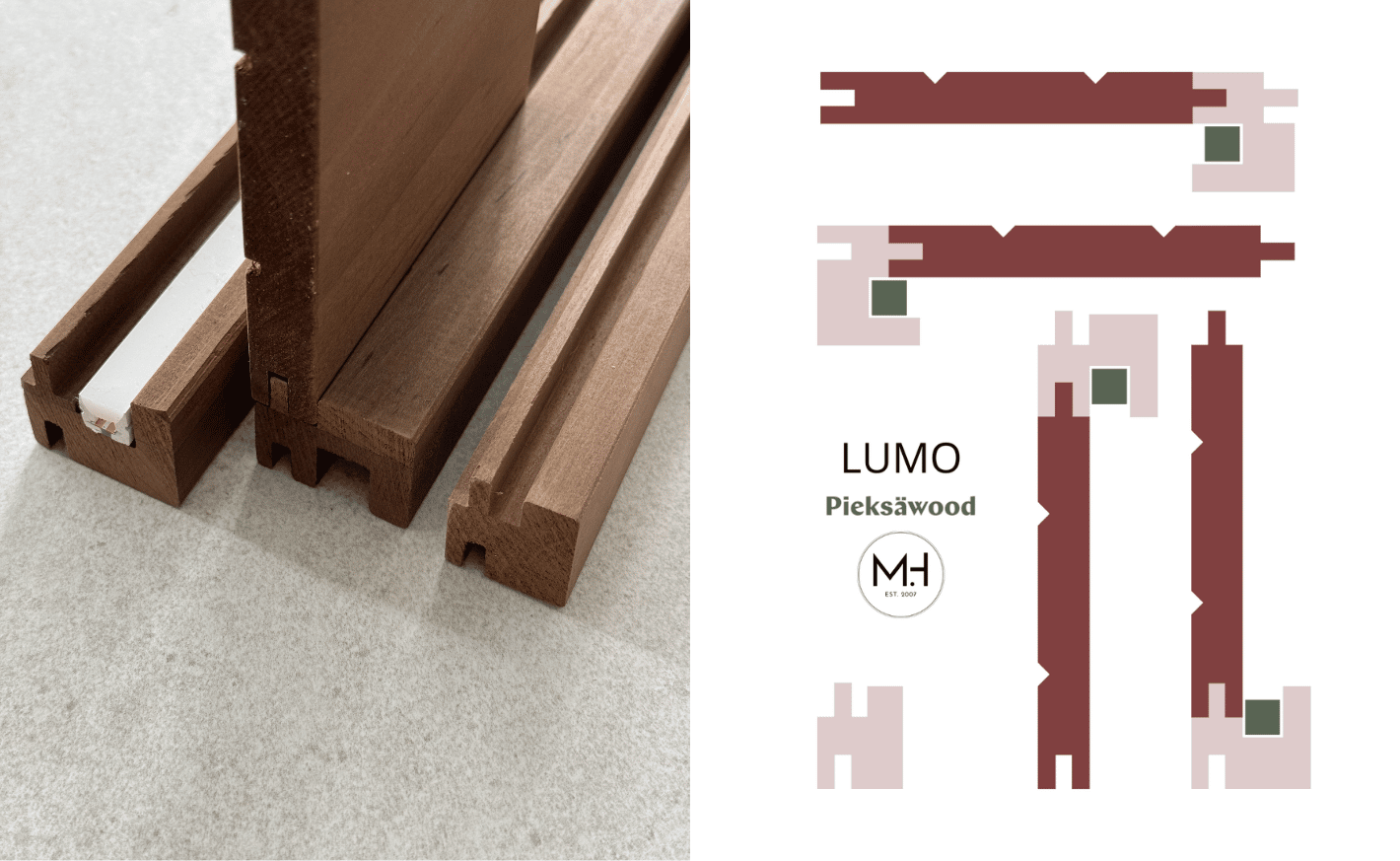
The LUMO panel designed by Minna for Pieksäwood. Here, the panel is made of dark, heat-treated Finnish aspen. Images: Minna Haapakoski
"A current trend is to install indirect lighting in both saunas and bathrooms, including behind panelled ceilings. The LUMO product family helps with this kind of lighting, because building the frame becomes significantly easier. The LUMO panels have grooves already milled to fit Cariitt's Ultra Ambient white Top IP67, which can be installed in a sauna ceiling too. There is no longer any need to build a separate recess for the light strip on site," Minna says of her brand-new design.
WORKING METHODS OF AN INTERIOR ARCHITECT
Working as a solo entrepreneur is versatile and gives freedom: "None of my working days look alike. I work from my home office. Sometimes I work from our holiday home by the sea. I often meet clients in their homes, so I travel a lot and see one fascinating home and space after another. That helps me get into clients' style and is an amazing kind of richness. The lovely thing about this profession is that, in a way, it does not even feel like work. Creative days are especially wonderful," Minna says.
BIM is a key part of Minna's work: "Archicad has been in use since the start of my business and is my most important tool. I start drawing all of my projects in Archicad already at the sketching stage. I also use the program in product design. The 3D plans help both me and especially my clients understand the whole picture. The design software also adds efficiency to the work," Minna says of her ways of working.
SOURCES OF INSPIRATION
Minna gets a lot of inspiration from getting to see so many different homes. She particularly likes 1970s architecture and is always pleased when she can visit buildings from that era. Beyond architecture, Minna draws inspiration from other sources too: "My ideas often come from nature. Color combinations and shapes in the landscape outside the window bring inspiration. Our holiday home by the sea, surrounded by forest, is an important place to reset and a source of inspiration."
Inspiration and ideas for projects often arrive unnoticed, Minna says: "There is always a camera in my bag for unexpected inspiration. When you watch a film, for example, you certainly pick up ideas, but you do not always realise you are doing it. From holidays I almost always come back with inspiration too, from hotels and Airbnb apartments and their interiors and lighting solutions."
Nature also recurs in her project material choices: "I aim to design with genuine, durable natural materials. It is good to remember that everything does not always need to be renewed. The result can often be even more interesting when you combine new and old."
ENTHUSIASM IS CONTAGIOUS
During the interview, Minna's almost tangible enthusiasm spread to me too. She has noticed the same with clients: "My super-power as a designer is absolutely the ability to get excited about every new project together with the client. One of the loveliest, most memorable moments is when a client bursts into happy tears after seeing the finished design. Can a designer wish for better thanks than that?"
Minna is an approachable person and designer, and that helps her work: "I am easy to get to know, and that is a richness in this profession, because clients find it easy to open up to me and tell me about their needs and wishes. And in return, my clients motivate me the most. When I can show clients a solution to a functional challenge and they realise they would not have come up with it themselves, it is really rewarding. Another lovely thank-you is when old clients get back in touch because they need design help again. Over the years I have got to design for several families more than once."
Her passion for the profession has not faded in 20 years: "Whatever the size or kind of project, I get excited immediately and start thinking how I will solve it, especially in terms of space. Sometimes a client has little space and you have to think how all of their wishes will fit. It is wonderful to solve functional problems. That is one of my favourite themes. And here, the architect's modelling software is an extremely good tool, because you can quickly produce different alternatives," Minna sums up.